
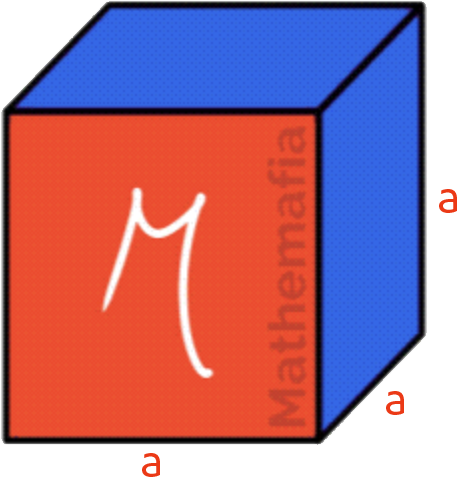
-
Perfect for quick revision and last-minute prep!
This is an interactive, colorful and extremely engaging 💕 comprehensive ✅ list of formulas of Class 10 Mathematics. This is a one-stop 🎯 solution for the students to quickly review / recall all formulas that would be very helpful especially for last minute revision before their math exam.
Click a link displayed below to read the corresponding chapter’s formulas.
- Ch 01 – Real Numbers
- Ch 02 – Polynomials
- Ch 03 – Pair of Linear Equations in Two Variables
- Ch 04 – Quadratic Equations
- Ch 05 – Arithmetic Progressions
- Ch 06 – Triangles
- Ch 07 – Coordinate Geometry
- Ch 08 – Introduction to Trigonometry
- Ch 09 – Some Applications of Trigonometry
- Ch 10 – Circles
- Ch 11 – Areas Related to Circles
- Ch 12 – Surface Areas and Volumes
- Ch 13 – Statistics
- Ch 14 – Probability

Chapter 1 - Real Numbers
Square root of any prime number is irrational.
E.g. – \( \begin{aligned} &\sqrt{2}, \sqrt{3}, \sqrt{5}, \sqrt{7} \end{aligned}\)
Every composite number can be factorised as a product of primes, and this factorisation is unique.
Click here to watch its proofTheorem
If p is a prime and p divides a2, then p divides a, where a is a positive integer.
Click here to watch its proofChapter 2 - Polynomials
Linear Polynomial
Degree = 1
No. of real zeros: At most 1
E.g: x
Quadratic Polynomial
Degree = 2
No. of real zeros: At most 2
E.g: x2
Cubic Polynomial
Degree = 3
No. of real zeros: At most 3
E.g: x3
Monomial
No: of terms = 1
E.g: 2x
Binomial
No: of terms = 2
E.g: 2x + 3
Trinomial
No: of terms = 3
E.g: 2x2 + 3x + 2
Quadratic Polynomials
Standard form of Quadratic Polynomial
\( \begin{aligned} &ax^2+bx+c, \ \ a\ne0\\ \end{aligned}\)Zeros of Quadratic Polynomial
If α is a zero of polynomial
\( \begin{aligned} &p(x) = ax^2+bx+c, \ \ a\ne0\\ &then \ \ p(α) = 0 \end{aligned}\)Sum of Zeros
\( \begin{aligned} &α + β = -\frac{b}{a} \end{aligned}\)
Product of Zeros
\( \begin{aligned} &α \times β = \frac{c}{a} \end{aligned}\)
Add Graphs – Later XXXXXXXXXXXXXXXXXXXXXXXXXXXXXXXX
Chapter 3 - Pair of Linear Equations in Two Variables
Standard form of Linear Equation in Two Variables
\( \begin{aligned} &ax+by+c =0,\\ &\text{where a and b are not both 0.} \end{aligned}\)OR
\( \begin{aligned} &ax+by+c =0, \ \ where \ \ a^2+b^2\ne 0 \end{aligned}\)Standard form of Pair of Linear Equation in Two Variables
\( \begin{aligned} &a_{1}x+b_{1}y+c_{1} =0, \ \ where \ \ a_{1}^2+b_{1}^2\ne 0 \\&a_{2}x+b_{2}y+c_{2} =0, \ \ where \ \ a_{2}^2+b_{2}^2\ne 0 \end{aligned}\)Solution of Pair of LE in 2 Variables
Intersecting Lines
➤ Consistent Pair of LE
➺ Lines Intersect at 1 point
🎯 No. of Solutions = 1
Coincident Lines
➤ Consistent Pair of LE
➺ Lines overlap each other
🎯 No. of Solutions = Infinite
\( \begin{aligned} &\frac{a_{1}}{a_{2}} = \frac{b_{1}}{b_{2}} = \frac{c_{1}}{c_{2}} \end{aligned}\)Parallel Lines
➤ inconsistent Pair of LE
➺ No common point
🎯 No. of Solutions = 0
\( \begin{aligned} &\frac{a_{1}}{a_{2}} = \frac{b_{1}}{b_{2}} \ne \frac{c_{1}}{c_{2}} \end{aligned}\)Chapter 4 - Quadratic Equations
Standard form of Quadratic Equation
\( \begin{aligned} &ax^2+bx+c=0, \ \ a\ne0\\ \end{aligned}\)Roots of Quadratic Equation
Zeros of quadratic polynomial \( \begin{aligned} &ax^2+bx+c \end{aligned}\)
➤ Roots of the quadratic equation \( \begin{aligned} &ax^2+bx+c=0 \end{aligned}\)
are the same.
Sum of Roots
\( \begin{aligned} &α + β = -\frac{b}{a} \end{aligned}\)
Product of Roots
\( \begin{aligned} &α \times β = \frac{c}{a} \end{aligned}\)
Nature of Roots
Discriminant
\( \begin{aligned} &D = b^2-4ac \end{aligned}\)D = 0
2 Equal, Real Roots
(coincident roots)
D < 0
No Real Roots
➤ Roots of the QE are
\( \begin{aligned} &x=\frac{-b ± \sqrt{D}}{2a} \end{aligned}\)Chapter 5 - Arithmetic Progression
General Form of AP
a, a + d, a + 2d, a + 3d, . . .
First Term: a
Common Difference: d
➺ d can be +ve, -ve or 0
\( \begin{aligned} &a_{2} -a_{1}=a_{3} -a_{2}=a_{4} -a_{3}=…=a_{n} -a_{n-1}=d \end{aligned}\)
nth Term of AP
\( \begin{aligned} &a_{n} = a +(n-1)d \end{aligned}\)
Sum of first n Terms
\( \begin{aligned} &S_{n} =\frac{n}{2}[2a+(n-1)d] \end{aligned}\)Sum of first n Terms
\( \begin{aligned} &S_{n} =\frac{n}{2}(a+l) \\&\text{where }l \text{ is the last term}\end{aligned}\)
📌 Super important 🔥
Total terms in AP: 25
11th term from the end = 25 – 11 + 1 = 15th Term
If a, b, c are in AP, then
\( \begin{aligned} &b=\frac{a+c}{2} \end{aligned}\)Chapter 6 - Triangles
Similar Figures
➺ Same shape
➺ Not necessarily the same size
🦆 🦆 🔺🔺
➺ All Circles are similar 🔵
➺ All Squares are similar 🟩
➺ All Equilateral Triangles are similar 🔺
➺ All Congruent figures are similar ✅
❌ All similar figures are not congruent
🔺 🔺 Similar Triangles 🔺🔺
Two Triangles ABC and DEF are similar if
➺ their corresponding angles are equal
\( \begin{aligned} &\angle A = \angle D, \ \ \angle B = \angle E, \ \ \angle C = \angle F\end{aligned}\)
➺ & their corresponding sides are in the same ratio (proportion).
\( \begin{aligned} &\frac{AB}{DE}=\frac{BC}{EF}=\frac{CA}{FD}\end{aligned}\)
Basic Proportionality Theorem (Thales Theorem)
If a line is drawn parallel to one side of a triangle to intersect the other two sides in distinct points, the other two sides are divided in the same ratio.
Converse of Basic Proportionality Theorem
If a line divides any two sides of a triangle in the same ratio then the lines is parallel to the third side.
Triangles Similarity Criteria
If Corresponding Sides are in the same ratio, then the ▲s are similar.
\( \begin{aligned} &\frac{AB}{DE}=\frac{BC}{EF}=\frac{CA}{FD}\end{aligned}\)If Corresponding Angles are equal, then the ▲s are similar.
\( \begin{aligned} \angle A &= \angle D,\\ \angle B &= \angle E,\\ \ \ \angle C &= \angle F\end{aligned}\)If one angle of a triangle is equal to one angle of another triangle and the sides including this angle are in the same ratio, then the ▲s are similar. For e.g.
\( \begin{aligned} \frac{AB}{DE}&=\frac{BC}{EF} \ \ \\ \angle B &= \angle E \end{aligned}\)If in two right angled ▲s, hypotenuse and one side of a ▲ are proportional to hypotenuse and one side of the other ▲, then the ▲s are similar.
If two angles of one ▲ are respectively equal to the two angles of the other ▲, then the two ▲s are similar.
\( \begin{aligned} \angle A &= \angle D,\\ \angle B &= \angle E\end{aligned}\)
This case is same as AAA because 3rd angle will be equal as well.
Chapter 7 - Coordinate Geometry
Abscissa / x-coordinate
The distance of a point from the y-axis
Ordinate / y-coordinate
The distance of a point from the x-axis
Distance Formula
Distance between points A (x1, y1) and B (x2, y2)
OR
Distance from origin
Distance of point A (x, y) from origin O (0, 0)
Section Formula
Mid-Point Formula
Chapter 8 - Introduction to Trigonometry
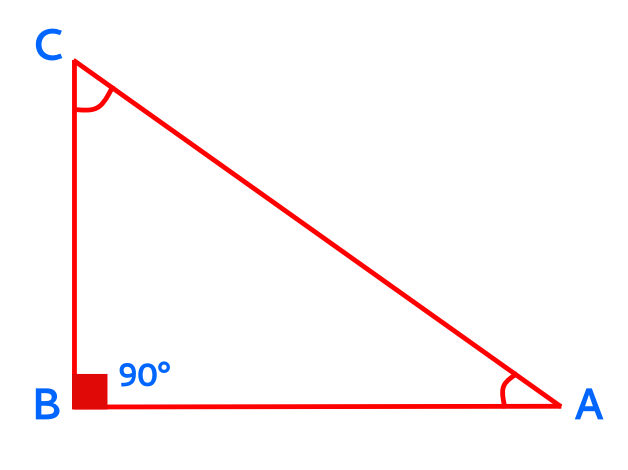
For Angle A
BC – Perpendicular
AB – Base
AC – Hypotenuse
For Angle C
AB – Perpendicular
BC – Base
AC – Hypotenuse
Trigonometric Ratios
P B P – Pandit Badri Prasad
H H B – Har Har Bole
\( \begin{aligned} sinθ = \frac{P}{H}\end{aligned}\)
\( \begin{aligned} &cosθ = \frac{B}{H}\end{aligned}\)
\( \begin{aligned} &tanθ = \frac{P}{B}\end{aligned}\)
\( \begin{aligned} &cosecθ = \frac{H}{P}\end{aligned}\)
\( \begin{aligned} &secθ = \frac{H}{B}\end{aligned}\)
\( \begin{aligned} &cotθ = \frac{B}{P}\end{aligned}\)
Imp Relationships b/w ratios
\( \begin{aligned} &sin θ= \frac{1}{cosecθ}\end{aligned}\)
\( \begin{aligned} &cos θ= \frac{1}{secθ}\end{aligned}\)
\( \begin{aligned} &tan θ= \frac{1}{cotθ}\end{aligned}\)
Trigonometric ratios of standard angles
| ∠A | 0° | 30° | 45° | 60° | 90° |
|---|---|---|---|---|---|
|
sin A |
0 |
\(\begin{aligned} \frac {1}{2}\end{aligned} \) |
\(\begin{aligned} \frac {1}{\sqrt{2}}\end{aligned} \) |
\(\begin{aligned} \frac {\sqrt{3}}{2}\end{aligned} \) |
1 |
|
cos A |
1 |
\(\begin{aligned} \frac {\sqrt{3}}{2}\end{aligned} \) |
\(\begin{aligned} \frac {1}{\sqrt{2}}\end{aligned} \) |
\(\begin{aligned} \frac {1}{2}\end{aligned} \) |
0 |
|
tan A |
0 |
\(\begin{aligned} \frac {1}{\sqrt {3}}\end{aligned} \) |
1 |
\(\begin{aligned} \sqrt {3} \end{aligned} \) |
N.D. |
|
cosec A |
N.D. |
2 |
\(\begin{aligned} \sqrt {2} \end{aligned} \) |
\(\begin{aligned} \frac {2}{\sqrt{3}}\end{aligned} \) |
1 |
|
sec A |
1 |
\(\begin{aligned} \frac {2}{\sqrt{3}}\end{aligned} \) |
\(\begin{aligned} \sqrt{2}\end{aligned} \) |
2 |
N.D. |
|
cot A |
N.D. |
\(\begin{aligned} \sqrt{3}\end{aligned} \) |
1 |
\(\begin{aligned} \frac {1}{\sqrt{3}}\end{aligned} \) |
1 |
N.D. – Not Defined
Trigonometric Identities
\( \begin{aligned} &sin^2θ+cos^2θ =1\end{aligned}\)
\( \begin{aligned} &1+tan^2θ =sec^2θ\end{aligned}\)
\( \begin{aligned} &1+cot^2θ =cosec^2θ\end{aligned}\)
Chapter 9 - Some Applications of Trigonometry
This chapter is about the applications of the formulas that we learnt in the previous chapter. You Students are recommended to practice different types of questions to master this chapter.
Chapter 10 - Circles

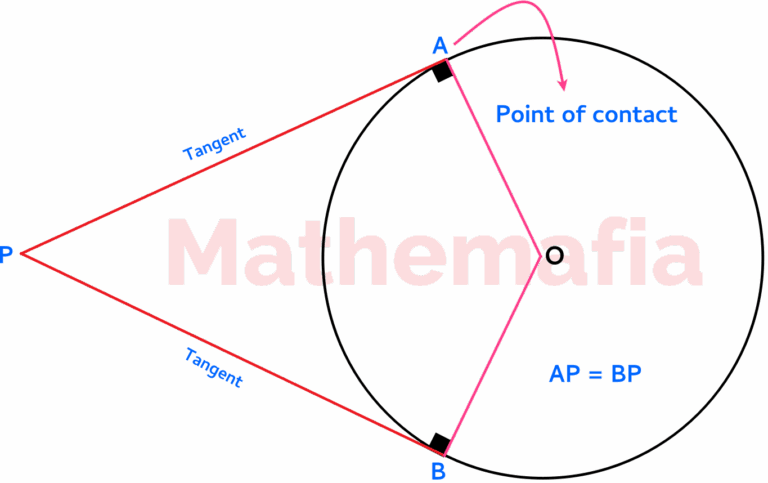
Tangent
Line that intersects the circle at only one point
Important
➺ Diameter is the longest chord
➺ Tangent is perpendicular to the radius through the point of contact
➺ A circle has infinitely many tangents
Theorem
The tangent at any point of a circle is perpendicular to the radius through the point of contact.
Theorem
The lengths of tangents drawn from an external point to a circle are equal.
Chapter 11 - Areas Related to Circles
Area of Circle = πr2
Circumference of Circle = 2πr
Area of a Sector
\(\begin{aligned}&\bbox[15px, border: 3px solid green;]{\color{red}{\frac{θ}{360}} \color{black}\times \color{blue}{\pi r^2}}\end{aligned}\)Length of Arc
\(\begin{aligned}&\bbox[15px, border: 3px solid green;]{\color{red}{\frac{θ}{360}} \color{black}\times \color{blue}{2\pi r}}\end{aligned}\)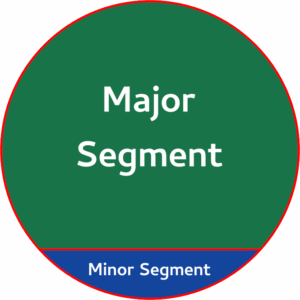
Area of a Segment
=
Area of the corresponding sector
– Area of the corresponding triangle
Area of Major Sector = Area of Circle – Area of Minor Sector
Area of Major Segment = Area of Circle – Area of Minor Segment
Chapter 12 - Surface Areas and Volumes
- HS – Hemisphere
- SA – Surface Area
- CSA – Curved Surface Area
- TSA – Total Surface Area
- LSA – Lateral Surface Area
Surface Areas
TSA of a Cube
\(\begin{aligned}&\bbox[15px, border: 3px solid green;]{\color{red}{6} \color{blue}{a^2}}\end{aligned}\)LSA of a Cube
\(\begin{aligned}&\bbox[15px, border: 3px solid green;]{\color{red}{4} \color{blue}{a^2}}\end{aligned}\)TSA of a Cuboid
\(\begin{aligned}&\bbox[15px, border: 3px solid green;]{\color{red}{2} \color{blue}{(lb + bh + hl)}}\end{aligned}\)LSA of a Cuboid
\(\begin{aligned}&\bbox[15px, border: 3px solid green;]{\color{red}{2h} \color{blue}{(l + b)}}\end{aligned}\)SA of a Sphere
\(\begin{aligned}&\bbox[15px, border: 3px solid green;]{\color{red}{4} \color{blue}{\pi r^2}}\end{aligned}\)CSA of a Solid HS
\(\begin{aligned}&\bbox[15px, border: 3px solid green;]{\color{red}{2} \color{blue}{\pi r^2}}\end{aligned}\)TSA of a Solid HS
\(\begin{aligned}&\bbox[15px, border: 3px solid green;]{\color{red}{2} \color{blue}{\pi r^2} + \color{magenta}{\pi r^2}} \end{aligned}\)TSA of a Hollow HS
\(\begin{aligned}&\bbox[15px, border: 3px solid green;]{\color{red}{2} \color{blue}{\pi r^2} + \color{red}{2} \color{blue}{\pi r^2} } \end{aligned}\)CSA of a Solid Cylinder
\(\begin{aligned}&\bbox[15px, border: 3px solid green;]{ \color{blue}{2 \pi r} \color{red}{h} } \end{aligned}\)TSA of a Solid Cylinder
\(\begin{aligned}&\bbox[15px, border: 3px solid green;]{ \color{blue}{2 \pi r} \color{red}{h} + \color{red}{2}\color{blue}{\pi r^2} } \end{aligned}\)CSA of a Hollow Cylinder
\(\begin{aligned}&\bbox[15px, border: 3px solid green;]{\color{red}{2} \color{blue}{ \pi r} \color{red}{h} + \color{red}{2} \color{blue}{ \pi r} \color{red}{h}} \end{aligned}\)TSA of a Hollow Cylinder
with Base
\(\begin{aligned}&\bbox[15px, border: 3px solid green;]{ \color{red}{4} \color{blue}{\pi r} \color{red}{h} +\color{red}{2} \color{blue}{\pi r^2} } \end{aligned}\)CSA of a Solid Cone
\(\begin{aligned}&\bbox[15px, border: 3px solid green;] {\color{blue}{\pi rl}} \end{aligned}\)TSA of a Solid Cone
\(\begin{aligned}&\bbox[15px, border: 3px solid green;]{\color{blue}{\pi rl} + \color{red}{\pi r^2}} \end{aligned}\)CSA of a Hollow Cone
\(\begin{aligned}&\bbox[15px, border: 3px solid green;] {\color{red}{2} \color{blue}{\pi rl}} \end{aligned}\)TSA of a Hollow Cone
\(\begin{aligned}&\bbox[15px, border: 3px solid green;] {\color{red}{2} \color{blue}{\pi rl}} \end{aligned}\)Volumes
Volume of a Cube
\(\begin{aligned}&\bbox[15px, border: 3px solid green;]{\color{blue}{a^3} } \end{aligned}\)Volume of a Cuboid
\(\begin{aligned}&\bbox[15px, border: 3px solid green;]{\color{blue}l \color{black} \times \color{green}b \color{black}\times \color{red}h} \end{aligned}\)Volume of Sphere
\(\begin{aligned}&\bbox[15px, border: 3px solid green;]{\color{red}{\frac{4}{3}}\color{blue}{\pi r^3}} \end{aligned}\)Volume of HS
\(\begin{aligned}&\bbox[15px, border: 3px solid green;]{\color{red}{\frac{2}{3}}\color{blue}{\pi r^3}} \end{aligned}\)Volume of Cylinder
\(\begin{aligned}&\bbox[15px, border: 3px solid green;]{\color{blue}{\pi r^2} \color{red}{h} } \end{aligned}\)Volume of Cone
\(\begin{aligned}&\bbox[15px, border: 3px solid green;]{\color{red}{\frac{1}{3}}\color{blue}{\pi r^2} \color{red}{h} } \end{aligned}\)Chapter 13 - Statistics
Direct Method
\(\begin{aligned} &\bbox[15px, border: 3px solid green;]{\overline{x} = \frac{\sum {f_ix_i}}{\sum{f_i}}} \end{aligned}\)Assumed Mean Method
\(\begin{aligned} &\bbox[15px, border: 3px solid green;]{\overline{x} = a +\frac{\sum {f_id_i}}{\sum{f_i}}} \end{aligned}\)Step Deviation Method
\(\begin{aligned} &\bbox[15px, border: 3px solid green;]{\overline{x} = a +\frac{\sum {f_iu_i}}{\sum{f_i}}\times h }\end{aligned}\)Mode of Grouped Data
\(\begin{aligned} &\bbox[15px, border: 3px solid green;]{l +\frac{f_1-f_0}{2f_1-f_0-f_2}\times h }\end{aligned}\)Median of Grouped Data
\(\begin{aligned}&\bbox[15px, border: 3px solid green;]{l +\frac{\frac{n}{2}-cf}{f}\times h }\end{aligned}\)Class Marks
\(\begin{aligned}&\bbox[15px, border: 3px solid green;]{\frac{\text{Upper Class Limit}- \text{Lower Class Limit}}{2}}\end{aligned}\)Chapter 14 - Probability
Experiment: Throwing a dice 🎲
Outcomes: { 1, 2, 3, 4, 5, 6 }
Total no. of outcomes = 6
P(1) = P(2) = P(3) = P(4) = P(5) = P(6) = 1/6
➺ Outcomes are Equally Likely
Examples of Events
E1: Getting 3
E2: Getting a number > 4
E3: Getting a number < 7
E4: Getting a prime number
E5: Getting a number < 1
E – An Event 0 ≤ P(E) ≤ 1
\( \begin{aligned} &P(E) = \frac{\text{No. of favourable outcomes}}{\text{Total no. of outcomes}} \end{aligned}\)
Probability of Events (E1 – E5)
E1: Getting 3
Favourable Outcome: { 3 }
No. of favourable outcomes = 1
\( \begin{aligned} P(E1)=\frac{1}{6} \end{aligned}\)
E2: Getting a number > 4
Numbers > 4: { 5, 6 }
No. of favourable outcomes = 2
\( \begin{aligned} P(E2)=\frac{2}{6} =\frac{1}{3} \end{aligned}\)
E3: Getting a number < 7
Numbers < 7: { 1, 2, 3, 4, 5, 6 }
No. of favourable outcomes = 6
\( \begin{aligned} P(E3)=\frac{6}{6} =1 \end{aligned}\)
Sure Event
E4: Getting a prime number
Prime numbers: { 2, 3, 5 }
No. of favourable outcomes = 3
\( \begin{aligned} P(E4)=\frac{3}{6} =\frac{1}{2} \end{aligned}\)
E5: Getting a number < 1
Number < 1: None
No. of favourable outcomes = 0
\( \begin{aligned} P(E5)=\frac{0}{6} =0 \end{aligned}\)
Impossible Event
Sure Event 👍
E = It will rain OR it will not rain today
P(E) = 1Impossible Event 👎
E = It will rain AND it will not rain today
P(E) = 0
Complementary Events 🎭
E = It will rain today
not E = It will not rain today
P(E) + P(not E) = 1
Equally Likely & Not Equally Likely Outcomes
Randomly take a ball out of a bag of same sized 4 red and 2 blue balls 🔴 🔴 🔴 🔴 🔵 🔵
Experiment 1
Outcomes: Red Ball 🔴, Blue Ball 🔵
Total possible outcomes = 2
P(Red Ball) = 4/6 = 2/3
P(Blue Ball) = 2/6 = 1/3
➺ Outcomes are Not Equally Likely
Experiment 2
Outcomes: A Ball of any color
(Color doesn’t matter)
Total possible outcomes = 6
P(Ball 1) = P(Ball 2) = P(Ball 3) = P(Ball 4) = P(Ball 5) = P(Ball 6) = 1/6
➺ Outcomes are Equally Likely